- Packaged food must declare 9 mandatory allergens (cashew added April 2026). If an allergen is present above 10 ppm, it's declared — not hedged with "may contain."
- Soy and sesame are NOT mandatory. They're "recommended." Most big brands label them voluntarily. Some don't.
- Unlike packaged food, restaurants are generally not required to publish allergen information. The Food Labeling Act applies to packaged goods, not to meals served at restaurants, stalls, or izakayas.
- Konbini meals are your safest backup — every factory-sealed item carries full allergen info.
- Carry a written allergy card in Japanese. Verbal requests get lost in translation. A card with the right kanji gets read.
Japan's food allergen labeling system requires manufacturers to test packaged food down to 10 parts per million. If a product contains one of the nine mandatory allergens above that threshold, it's declared on the label — by law. The system doesn't rely on vague warnings. It's one of the strictest in the world.
Then you sit down at a restaurant, and the rules are different.
Japan's Food Labeling Act covers packaged, processed food. It does not require restaurants to disclose allergens on their menus or in conversation. Some chains do it voluntarily. Most independent restaurants don't. The same country that tests factory food for microscopic protein traces can serve you a bowl of soup with multiple allergens in it and no requirement to flag any of them.
That gap — between the packet and the plate — is what catches travelers with food allergies in Japan. Most travel guides cover it with a line like "be careful when eating out." This article covers the rest: how to read a Japanese food allergy label, what the mandatory and recommended allergen lists actually mean, and what to do at restaurants where the labeling system doesn't reach.
Japan's mandatory allergens: the list of nine
Japan's Consumer Affairs Agency (CAA) maintains the official list of allergens that must be declared on all packaged food sold in the country. As of April 2026, there are nine mandatory allergens:
| Allergen | Japanese (kanji / kana) | Mandatory since |
|---|---|---|
| Egg | 卵tamago | 2002 |
| Milk | 乳nyuu | 2002 |
| Wheat | 小麦komugi | 2002 |
| Buckwheat | そばsoba | 2002 |
| Peanut | 落花生rakkasei | 2002 |
| Shrimp | えびebi | 2008 |
| Crab | かにkani | 2008 |
| Walnut | くるみkurumi | 2023 |
| Cashew nut New | カシューナッツkashuu nattsu | April 2026 |
Cashew was added in April 2026 after Japan's national food allergy survey showed tree nut allergy cases had overtaken wheat, making them the second most common food allergy in the country — behind only eggs. Walnut was elevated to mandatory in 2023 after a tenfold increase in reported cases over the previous decade.
Two things stand out about this list. It includes buckwheat (soba) and shrimp/crab as individual mandatory items — neither of which appear on the US "Big 9" or the EU's 14 allergens. If you have a buckwheat allergy, Japan is one of the safer places to shop for packaged food, because it's always declared. On the other hand, soy and sesame — both mandatory in the US — are only "recommended" in Japan. That matters, and it's covered below.
The recommended twenty-one
Below the mandatory list sits a second tier: twenty-one ingredients that the CAA "strongly recommends" manufacturers label, but does not require by law. Most large manufacturers label them. Some smaller producers don't. You can't assume.
- Egg 卵
- Milk 乳
- Wheat 小麦
- Buckwheat そば
- Peanut 落花生
- Shrimp えび
- Crab かに
- Walnut くるみ
- Cashew カシューナッツ
- Almonds
- Abalone
- Squid
- Salmon roe
- Oranges
- Kiwifruit
- Beef
- Sesame ごま
- Salmon
- Mackerel
- Soybeans 大豆
- Chicken
- Bananas
- Pork
- Peaches
- Yams
- Apples
- Gelatin
- Macadamia nuts
- Pistachio New
- Matsutake
The ones that trip up travelers most often: soy and sesame. Soy is in soy sauce, miso, tofu, edamame, and dozens of sauces and dressings. Sesame is in goma-dare dipping sauces, sesame oil, and scattered across rice dishes. Both are everywhere in Japanese cooking, and both are only on the recommended list. A small manufacturer or a regional brand could legally leave them off the label.
If you have a soy or sesame allergy, don't rely on labels alone — especially on products from smaller producers. The major konbini chains (7-Eleven, FamilyMart, Lawson) label all 30 allergens voluntarily, but that's their corporate policy, not a legal requirement.
What does a Japan allergy label look like?
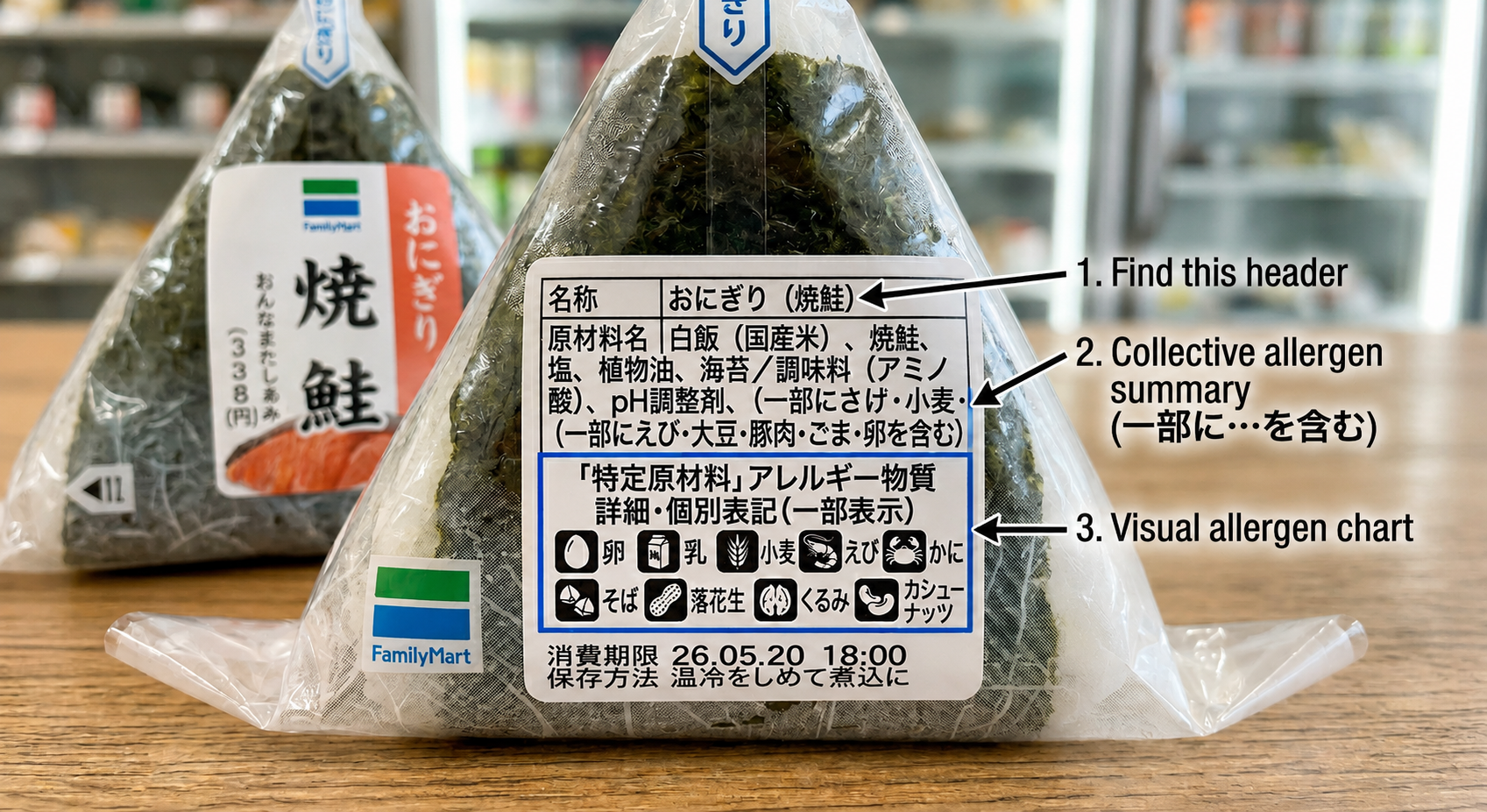
If you've never seen a Japanese food label before, here's how to read one. The layout is denser than a Western label, but once you know what to look for, you can scan it in seconds.
Every packaged food product has an ingredient block, usually on the back. Ingredients are listed under 原材料名 (genzairyou-mei). Allergens appear one of two ways:
Individual notation (個別表示, kobetsu hyouji): each ingredient that contains an allergen gets it noted in parentheses right after. So a sauce might read しょうゆ(小麦・大麦を含む) — soy sauce (contains wheat and barley).
Collective notation (一括表示, ikkatsu hyouji): all allergens are gathered into a single line at the end of the ingredient list, usually after the phrase 一部に…を含む ("partially contains…"). Something like: 一部に小麦・卵・乳成分・えび・大豆を含む — "contains wheat, egg, milk, shrimp, soy."
Most major konbini chains use the collective format. It's faster to scan: find that summary line and check for your allergen's kanji. If you memorise the kanji for your specific allergens (see the cheat sheet below), you can read a Japan allergy label in seconds without knowing any other Japanese.
Fresh deli items like oden from the hot counter, nikuman (steamed buns), and anything scooped or assembled in-store don't always carry full allergen labels. These aren't factory-sealed, so labeling requirements may not apply. Stick to sealed, factory-packaged items if you need certainty.
One more thing: mirin (みりん, sweet rice wine) and cooking sake (料理酒, ryourizake) appear in many prepared foods. Mirin is usually fine for wheat allergies, but some brands are processed on shared equipment with grain-based products. When in doubt, scan the allergen summary line — if wheat is present, it'll be declared there on any properly labeled domestic product.
No "may contain" — but what does that actually mean?
In the US, EU, and Australia, you'll see "may contain traces of peanuts" or "manufactured in a facility that processes tree nuts." These precautionary allergen labels (PAL) are common and mostly unregulated — manufacturers use them broadly as legal cover, whether or not there's a measured cross-contamination risk.
Japan takes a different approach. Rather than allowing vague precautionary wording, the CAA's position is that if an allergen protein is present in a product above 10 ppm — whether added intentionally or through cross-contamination — it should be declared as a labeled ingredient. The broad-stroke "may contain" format is not part of the Japanese labeling framework.
In practice, this means Japanese labels don't use the vague catch-all warnings you may be used to from Western products. When an allergen is listed, you can trust it reflects a real presence — not a blanket disclaimer.
"No may contain" doesn't mean "no cross-contamination warnings at all." Many Japanese manufacturers do include production-line statements — they're just phrased differently. Instead of "may contain traces of egg," you might see:
本品製造工場では卵を含む製品を生産しています
"This product is manufactured in a factory that also produces products containing egg." These read as regular prose within the label text, not as a separate warning box. They're easy to miss if you're only scanning for the allergen summary line.
When an allergen is not listed and no production-line statement is present, it doesn't guarantee absolute absence. It means either the allergen isn't present, or it falls below 10 ppm, or the manufacturer's testing didn't catch it. Discuss threshold tolerances with your allergist before relying on any labeling system.
A note on imported products
Everything above describes Japan's domestic labeling system — the rules that apply to food manufactured and packaged within Japan. If you're shopping at international supermarkets (Kaldi, Nissin World Delicatessen, National Azabu) or buying imported packaged goods, the labeling may follow a different format.
Imported products sold in Japan are technically required to carry Japanese-language allergen labeling that meets CAA standards. But in practice, you may encounter products with bilingual labels where the original country's conventions (including "may contain" warnings) are still visible, or products in specialty stores where labeling compliance varies. Don't assume an imported product follows the same system as a domestically labeled onigiri from 7-Eleven. When in doubt, read the Japanese-language portion of the label — that's the part subject to Japan's rules.
Where the system stops: restaurants
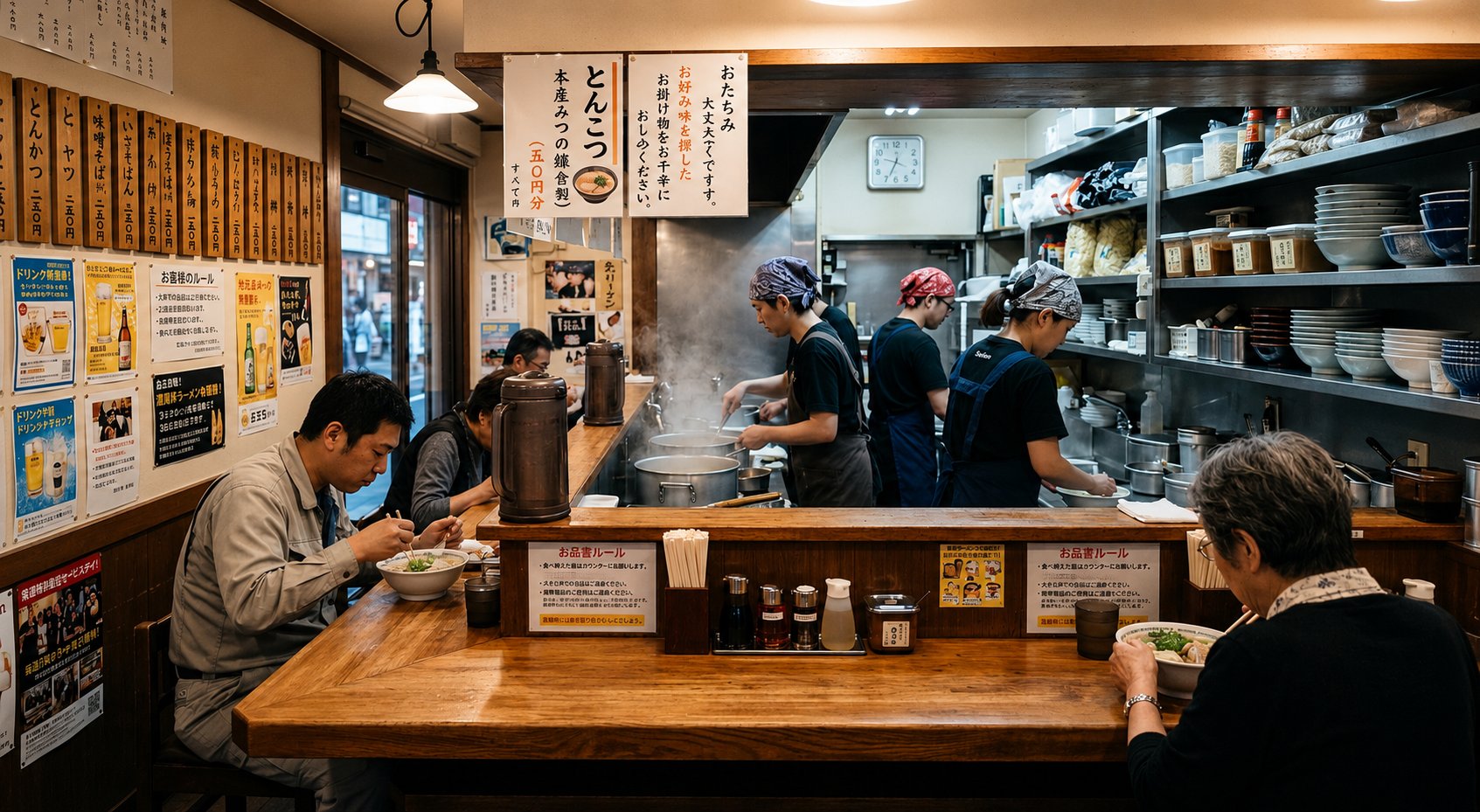
Everything above applies to packaged food. The moment you walk into a restaurant, izakaya, food stall, or ramen shop, the rules change.
Japan's Food Labeling Act applies to packaged, processed food — not to meals served at restaurants. Unlike the EU, where Regulation 1169/2011 requires restaurants to communicate allergen information (even if only verbally), Japan has no equivalent restaurant-level obligation. Some local health authorities issue voluntary guidance, and some chain restaurants adopt their own disclosure policies, but there is no national mandate.
In practice, this means the large majority of restaurants you'll walk into in Japan — especially independent ones — won't have allergen information available unless you ask. Some chain restaurants — Coco Ichibanya, MOS Burger, Matsuya, Sukiya — publish allergen matrices on their websites or on laminated sheets you can request. But these are business decisions, not legal requirements. The neighborhood tonkatsu place that's been open for forty years is unlikely to have an allergen chart.
The Japanese term for cross-contamination is コンタミネーション (kontamineeshon) — borrowed from English but not widely understood outside allergy-aware kitchens. Most restaurant staff haven't encountered the concept in a food-safety context. This isn't carelessness — food allergies in Japan are rising fast, but restaurant-level awareness hasn't kept pace with the packaged food industry's standards.
These are different conditions — wheat allergy is an IgE-mediated immune reaction, while celiac disease is an autoimmune response to gluten — but many of the same restaurant risks apply. See the dedicated section below for what this means on Japanese labels.
If you're celiac or gluten-free (not just wheat-allergic)
Japan's labeling system tracks wheat (小麦) as a mandatory allergen, but it does not separately track barley (大麦, oomugi) or rye (ライ麦, reimugi). Neither barley nor rye appears on the mandatory or recommended allergen lists.
If you have a wheat allergy, the labeling system works well — wheat is always declared on packaged food. But if you have celiac disease or need to avoid all gluten, "wheat-free" and "gluten-free" are not the same thing in Japan's labeling framework. A product could be free of wheat and still contain barley (common in mugicha barley tea, some miso varieties, and certain grain blends) without any allergen declaration.
At restaurants, the overlap is larger: wheat is in standard soy sauce (used in almost every cooked dish), in tempura batter, in the breading on tonkatsu and karaage, and in udon noodles that may share cooking water with soba. Assume any fried food shares a fryer with breaded items unless told otherwise. Gluten-free soy sauce is rarely stocked at restaurants (and tamari in Japan can still contain wheat) — bringing a small bottle of your own is practical, not excessive.
The word for gluten-free in Japanese is グルテンフリー (guruten furii). If you're celiac, your allergy card should specify gluten — not just wheat — and name barley and rye explicitly. The tabemasen gluten-free card includes this distinction in its phrasing.
Kanji cheat sheet for common allergens
Memorise the characters for your specific allergens. You don't need to read Japanese — you just need to recognize these on a label or menu.
Useful phrases
Lower-risk foods to know about
Not a comprehensive safe-food list — individual allergies vary, and cross-contamination is always possible. But these are generally simpler foods with fewer hidden ingredients, useful to know when you're unsure about a restaurant.
Soy sauce (shoyu) is so fundamental to Japanese cooking that it's used in prep contexts you wouldn't expect. Meats may be lightly pre-seasoned with soy before cooking. Grill surfaces carry residue from previous tare orders. Even when you order "plain" or "salt only," trace soy exposure is difficult to eliminate. If you have a soy allergy severe enough that trace contact matters, konbini packaged food is significantly safer than restaurant-prepared food.
Avoid: anything labeled タレ (tare — sauce, typically contains soy and wheat), anything fried (shared fryers), anything with a brown glaze (likely soy-based).
Food allergies and Japan travel: what works at restaurants
The labeling system protects you at the konbini. At restaurants, you need to do the work yourself. Here's what works in practice.
Carry a Japanese-language allergy card. Not a Google Translate screenshot — a properly phrased card in natural Japanese that names your allergens by their kanji, mentions cross-contamination (コンタミネーション), and is polite enough that staff will read it fully. This is what tabemasen generates for free — select your allergens and severity, and the card includes the right kanji and phrasing for each.
Lean on konbini meals when you're unsure. There's no shame in eating 7-Eleven onigiri for lunch when you're in a neighborhood with no allergy-friendly options. The allergen labeling on sealed konbini food is more reliable than most restaurants in any country.
Call ahead to ryokan and kaiseki restaurants. These places prepare multi-course meals hours or days in advance. If you tell them at booking — not at the table — they can usually accommodate allergies. Many ryokan booking forms ask about allergies specifically. Email your allergy card in advance so the chef can plan around your needs.
Know which restaurant types give you more visibility. Yakiniku (grill-your-own-meat) and teppanyaki let you see everything being cooked. Sushi counters show you the raw ingredients. Tempura shops are the opposite — shared fryers, wheat batter, high cross-contamination risk even for items that aren't battered themselves.
Learn your allergen's kanji. Saying "I have a wheat allergy" in English won't register at most restaurants. Showing 小麦アレルギー (komugi arerugii) on a card or phone screen will. A written card with specific ingredient names works better than a verbal exchange.
What this system gets right — and where it doesn't reach
Japan's allergen labeling on packaged food is among the best in the world. The mandatory testing thresholds, the restrictions on vague precautionary warnings, and the ongoing updates to the allergen list — cashew and pistachio in 2026, walnut in 2023 — reflect a system that responds to real epidemiological data.
The gap is at the restaurant level. Packaged food gives you lab-tested declarations. Restaurants give you nothing unless they choose to. Until legislation catches up — or voluntary disclosure becomes standard practice — travelers with food allergies need to fill that gap themselves. A card in Japanese. A list of kanji to scan for. And the knowledge that a konbini rice ball with a readable label is sometimes a better bet than a restaurant meal without one.
Common questions
Does Japan require allergen labeling at restaurants?
Japan's Food Labeling Act applies to packaged, processed food. It does not impose equivalent requirements on restaurants, izakayas, food stalls, or food sold unpackaged. Some chain restaurants publish allergen information voluntarily, but most independent restaurants don't. This contrasts with the EU, where restaurants must communicate allergen information under Regulation 1169/2011.
What are Japan's mandatory food allergens?
As of April 2026, there are nine: egg (卵), milk (乳), wheat (小麦), buckwheat (そば), peanut (落花生), shrimp (えび), crab (かに), walnut (くるみ), and cashew nut (カシューナッツ). Cashew was added in April 2026. A further 21 allergens — including soy, sesame, and almonds — are recommended but not legally required.
Does Japan use "may contain" labels?
Not in the Western sense. If an allergen is present above 10 ppm — including through cross-contamination — it's declared as a labeled ingredient. However, many manufacturers include production-line statements (e.g., "This product is manufactured in a factory that also produces products containing egg") — these read as regular prose, not a separate warning box. They're easy to overlook if you're only scanning the allergen summary line.
Is soy a mandatory allergen in Japan?
No — and this catches many travelers off guard. Soy (大豆, daizu) is on Japan's recommended list, not the mandatory list. That's the opposite of the US and EU, where soy is mandatory. Most large manufacturers label soy voluntarily, but smaller brands might not. If you have a soy allergy, check every label.
What changed in Japan's allergen labeling in 2026?
Two changes took effect in April 2026: cashew nut was moved from the recommended list to mandatory (making it the ninth mandatory allergen), and pistachio was added to the recommended list for the first time. Both changes followed Japan's national food allergy survey, which found tree nut allergies had become the second most common food allergy in the country. There is a two-year transition period for cashew labeling (full compliance required by March 2028).