Celiac (coeliac) disease in Japan
Japan's packaged-food labelling is among the strictest anywhere — but it covers wheat, not gluten. Barley and rye are on neither the mandatory nor the recommended allergen list, and outside one narrow rice-flour scheme, “gluten-free” has no enforced legal definition. For a celiac that changes what a label tells you, and what you have to check yourself.
Last reviewed October 2026 · Corrections
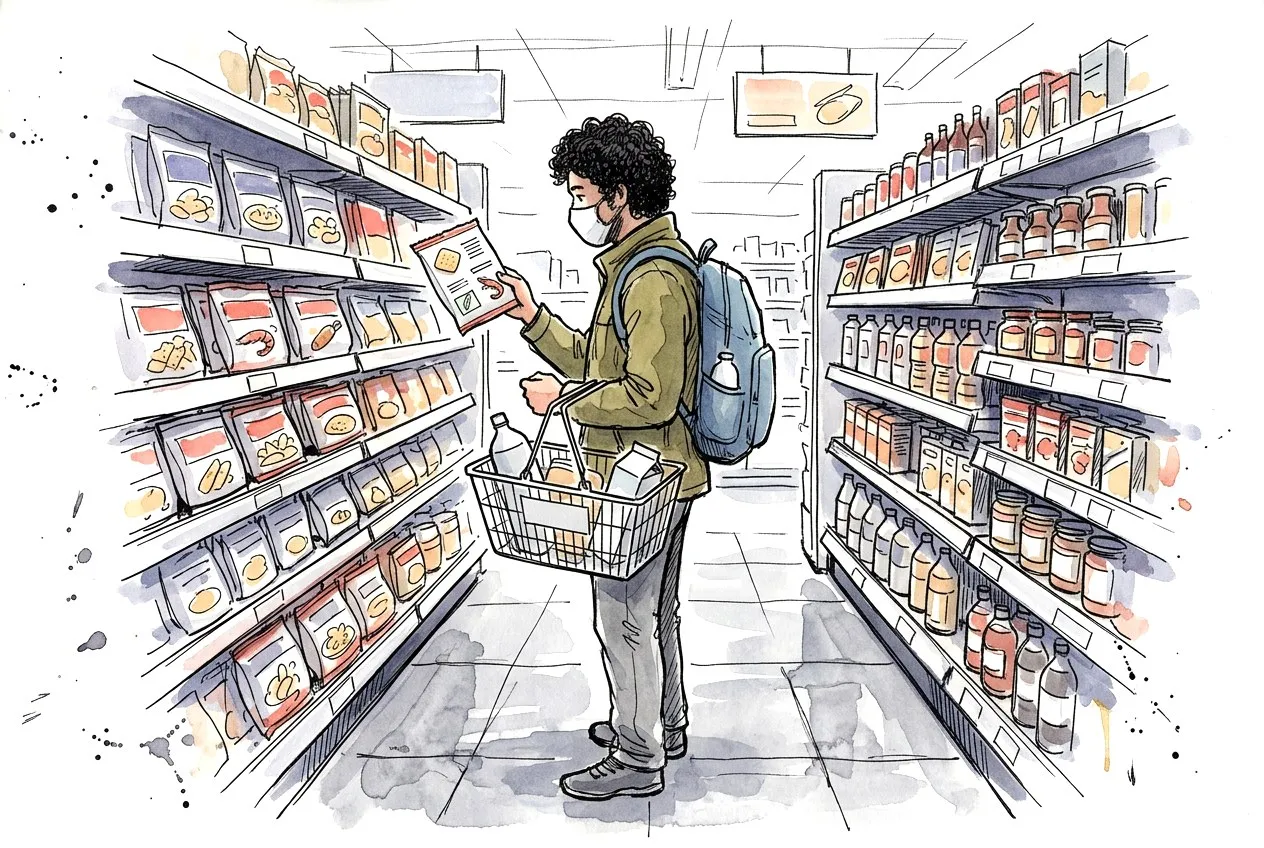
Japan labels wheat, not gluten
Japan requires nine allergens to be declared on packaged food — the tokutei genzairyo (特定原材料) list: shrimp, cashew nut, crab, walnut, wheat, buckwheat, egg, milk and peanut. Cashew nut is the most recent addition, moved from the recommended list to mandatory on 1 April 2026, with full compliance required by 31 March 2028 (amendment to the Food Labelling Standards). The Consumer Affairs Agency minuted the decision at its Food Allergy Labeling Advisory Meeting of 21 January 2025 (USDA FAS GAIN JA2025-0006). A recommended list of 20 further items sits alongside it. Our labeling guide covers the change in detail.
Celiac disease is spelled coeliac outside North America; both spellings mean the same condition, and this page uses the American form throughout for consistency with the card generator.
Barley and rye are on neither that list nor the 20-item recommended list. Neither is “gluten” as a category. For most allergies this is irrelevant. For celiac disease it is the single most important structural fact about eating in Japan.
The practical consequence: an allergen box with no 小麦 in it is not a gluten-free guarantee. Barley malt in a drink, barley in a mugi miso, roasted barley in the free tea — none of these trigger a mandatory allergen declaration, because barley is not a declarable allergen in Japan. They will usually still appear in the ordinary ingredients list, which is why the ingredients list, not the allergen summary, is the thing to read.
For how the labelling system works in full — the 10 ppm testing threshold, the recommended-list allergens, and why restaurants are exempt — see the Japan allergen labeling guide.
“Gluten-free” has almost no legal meaning in Japan
In the EU and the US, “gluten-free” is a regulated claim with a number behind it: the US FDA requires less than 20 ppm, and the European Commission 20 ppm or lower. Japan has no equivalent general standard.
It has one narrow scheme instead — and it is stricter than either. Japan's Ministry of Agriculture, Forestry and Fisheries issued “Labelling Guidelines to Promote Rice Flour Products” permitting rice flour containing 1 ppm or less of gluten to be labelled “Non-Gluten”, with third-party certification set up through the Japan Rice Flour Association (USDA Foreign Agricultural Service, GAIN report JA7094).
Three limitations matter more than the impressive threshold:
So: treat グルテンフリー printed on a package or menu as a marketing claim, not a regulated one. The certification mark on rice flour is the only Japanese label with a defined gluten threshold behind it.
The MAFF guidelines and the USDA analysis of them date from 2017. The 1 ppm threshold and the rice-flour scope are what that report documents; whether the scheme has since broadened is worth checking before you rely on it.
Celiac disease is rare here, and that shapes every conversation
This is not a cultural aside — it is the reason the usual script fails. A 2023 review of celiac disease in Japanese patients records (Int. J. Mol. Sci., 2023):
Two things follow. First, naming the diagnosis will usually not work. セリアック病 is a term many people — including some clinicians — will not have encountered. Naming the grains does work: 小麦, 大麦 and ライ麦 are concrete, everyday words. This is exactly why a written card lists the grains rather than announcing a condition.
Second, if you have a confirmed diagnosis, carry your own documentation. Do not plan on being re-diagnosed, or on a local clinician having ready access to celiac serology.
すみません、お願いがあります。
食事制限があります。
グルテン(小麦、大麦、ライ麦)を食べることができません。
以下のものを食べることができません:
・小麦
・大麦・ライ麦
・小麦を含む麺(うどん、ラーメン、そうめん、二八そばなど)
・てんぷら・お好み焼き
・麦味噌・合わせ味噌、麩(ふ)
・麦茶・麦芽(モルト)
※醤油は小麦不使用のものをお願いします(たまり醤油も小麦入りのことがあります)。なければ醤油なしで大丈夫です。天ぷら・フライと同じ油、めんのゆで汁、共用の調理器具は避けていただけると助かります。微量でも反応します。
これらが含まれていない料理はありますか?難しい場合は、遠慮なくおっしゃってください。
ご協力ありがとうございます。
Excuse me, I have a request.
I have dietary restrictions.
I cannot eat gluten (wheat, barley, rye).
I cannot eat the following:
• wheat
• barley, rye
• noodles with wheat (udon, ramen, somen, soba cut with wheat)
• tempura, okonomiyaki
• barley or blended miso, fu (dried wheat gluten)
• barley tea (mugicha), malt
Could you use soy sauce made without wheat? (Tamari can contain wheat too.) If you don't have any, no soy sauce is fine. It would help to avoid oil shared with tempura or fried food, noodle water, and shared cookware. Even a trace causes a reaction.
Are there any dishes that don't contain these? If it's difficult, please just say so.
Thank you for your help.
Please confirm ingredients with staff. This card helps you ask; it can't guarantee what's in the food. Carry your medication.
tabemasen.io
How to verify food yourself
Given all of the above, four habits do most of the work. These are checking techniques rather than a list of things to avoid — for the specific ingredients that catch people out, see where gluten hides in Japanese food.
Common questions about celiac disease in Japan
Does “no wheat” on a Japanese label mean the food is gluten-free?
No. Japan's mandatory allergen list covers nine items — shrimp, cashew nut, crab, walnut, wheat, buckwheat, egg, milk and peanut. Barley and rye are on neither the mandatory list nor the 20-item recommended list, so barley malt or roasted barley can be present in a product whose allergen box shows no wheat. Read the full ingredients list, not only the allergen declaration.
Is “gluten-free” legally defined in Japan?
Not in the general way it is in the EU or the US, where a 20 ppm threshold applies. Japan's only formal scheme is narrower and stricter: MAFF's rice flour labelling guidelines permit rice flour containing 1 ppm or less of gluten to be labelled “Non-Gluten”. It is voluntary, requires third-party certification, and covers only rice flour made from Japanese rice. Outside that scheme, グルテンフリー on a package or menu is a marketing claim rather than a regulated one.
What is the Japanese “Non-Gluten” certification mark?
A voluntary mark for rice flour certified at 1 ppm gluten or below, administered through third-party certification set up by the Japan Rice Flour Association. The threshold is stricter than the US FDA's less than 20 ppm and the European Commission's 20 ppm or lower. Its scope is the limitation: it applies to rice flour from Japanese rice, not to food in general.
Will restaurant staff in Japan know what celiac disease is?
Often not. Celiac disease is genuinely rare in Japan — one screening study found two biopsy-confirmed cases among 2,055 adults, and the HLA-DQ2 carrier rate is around 0.3 to 0.6 percent against 20 to 30 percent in Western Europe. Saying セリアック病 may not communicate anything at all. Naming the grains does: 小麦 (wheat), 大麦 (barley) and ライ麦 (rye) are concrete and recognisable in a way the diagnosis is not.
Do Japanese doctors test for celiac disease?
It is not routine. A 2023 review notes that celiac serology is often not covered by Japanese health insurance, that samples are frequently sent overseas for evaluation, and that few physicians and nutritionists have celiac expertise. If you have a confirmed diagnosis, carry your own documentation rather than expecting to be re-diagnosed locally.
Is soba safe if I have celiac disease?
Only if it is juwari soba (十割そば), made from 100% buckwheat with no wheat binder — and even then, not automatically. Most soba blends wheat flour in, because buckwheat has no gluten and is hard to bind without it. Two further checks matter for coeliac disease specifically. First, the boiling water: shops serving udon or nihachi soba alongside juwari commonly use one pot, reused through service, and Coeliac Australia is explicit that water used for wheat pasta must be discarded before gluten-free pasta goes in. Ask whether the noodles are boiled separately. Second, the dipping sauce: tsuyu is soy-sauce based, and standard Japanese soy sauce is brewed with wheat.
Generate a card that names the grains
Free, no signup, about 30 seconds. Lists wheat, barley and rye in Japanese, sets severity, and asks about shared oil and cookware.
Generate my Japanese celiac card →