Free restaurant card generator
Gluten-free in Japan
A free Japanese allergy card — sometimes called a chef card or translation card — that you show your waiter. It explains your restriction in polite Japanese, calls out wheat in soy sauce, noodles and miso, and asks about cross-contamination. The things phrasebooks miss.
Last reviewed October 2026 · Corrections
Red dot: Japan's mandatory allergens
More allergens, diets, your name and a custom line on the full card builder.
No signup · Free
Your card preview
Tap what you can't eat. Your card fills in as you go.
すみません、お願いがあります。
食事制限があります。
グルテン(小麦、大麦、ライ麦)を食べることができません。
以下のものを食べることができません:
・小麦
・大麦・ライ麦
・小麦を含む麺(うどん、ラーメン、そうめん、二八そばなど)
・てんぷら・お好み焼き
・麦味噌・合わせ味噌、麩(ふ)
・麦茶・麦芽(モルト)
※醤油は小麦不使用のものをお願いします(たまり醤油も小麦入りのことがあります)。なければ醤油なしで大丈夫です。天ぷら・フライと同じ油、めんのゆで汁、共用の調理器具は避けていただけると助かります。微量でも反応します。
これらが含まれていない料理はありますか?難しい場合は、遠慮なくおっしゃってください。
ご協力ありがとうございます。
Excuse me, I have a request.
I have dietary restrictions.
I cannot eat gluten (wheat, barley, rye).
I cannot eat the following:
• wheat
• barley, rye
• noodles with wheat (udon, ramen, somen, soba cut with wheat)
• tempura, okonomiyaki
• barley or blended miso, fu (dried wheat gluten)
• barley tea (mugicha), malt
Could you use soy sauce made without wheat? (Tamari can contain wheat too.) If you don't have any, no soy sauce is fine. It would help to avoid oil shared with tempura or fried food, noodle water, and shared cookware. Even a trace causes a reaction.
Are there any dishes that don't contain these? If it's difficult, please just say so.
Thank you for your help.
Please confirm ingredients with staff. This card helps you ask; it can't guarantee what's in the food. Carry your medication.
tabemasen.io
Is Japan celiac-friendly?
More than most people expect. Japanese cuisine is built on rice, fish, and vegetables — all naturally gluten-free. You can eat very well in Japan as a celiac if you know where the hidden wheat is.
The problem isn't that safe food doesn't exist. It's that gluten hides in things that look safe. Soy sauce contains wheat. The free tea at your table might be barley. That clear soup has dashi in it, and some dashi contains soy sauce. None of this is obvious, and most restaurant staff don't know — because to them, soy sauce is just shoyu. It's not something they think of as containing wheat.
Japan's mandatory allergen labeling is among the strictest in the world, but it only covers packaged food. In restaurants, you're on your own — which is exactly why a written card in Japanese works better than trying to explain it verbally.
One thing worth knowing before you rely on a label: Japan's allergen law covers wheat, not gluten — barley and rye are on neither the mandatory nor the recommended list. If you have coeliac disease rather than a wheat allergy, that distinction matters, and celiac disease in Japan covers what a Japanese label actually guarantees.
Where gluten hides in Japanese food
These are the ingredients that catch most gluten-free travelers in Japan. Some are obvious (ramen), but others — soy sauce, barley tea, curry roux — surprise even well-prepared celiacs.
What celiacs can eat in Japan
Japan has more naturally gluten-free food than most countries. Once you know what to avoid, the list of what's safe is long.
Why a written card works better than speaking Japanese
Even if you memorise the phrase for "I can't eat wheat," a card works better in practice. Here's why.
The tabemasen card is customisable: it already tells the kitchen that even a trace causes a reaction, you can combine it with other dietary needs and allergies, and it generates in seconds.
Common questions about eating gluten-free in Japan
Can celiacs eat sushi in Japan?
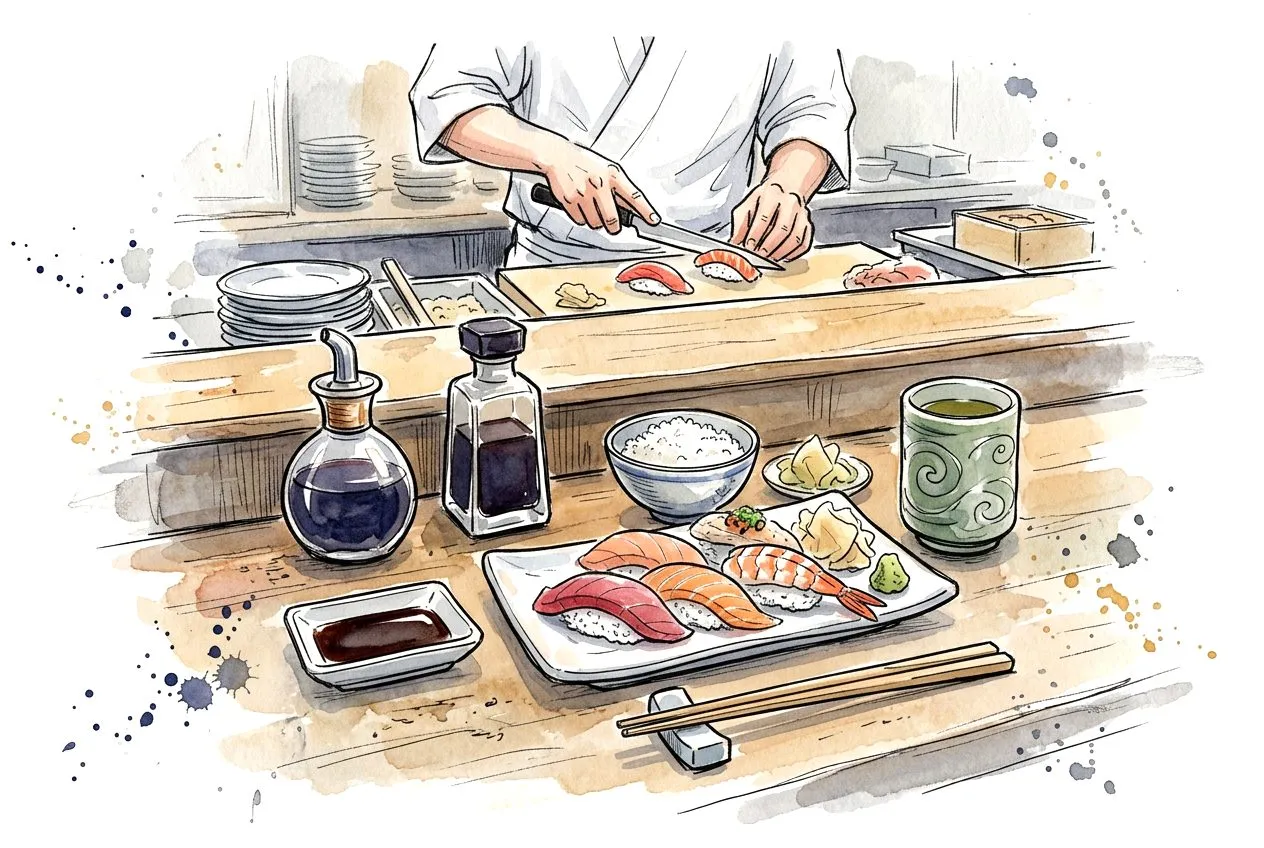
Yes — the rice and fish are naturally gluten-free. The problem is soy sauce, which contains wheat. Bring your own soy sauce labelled gluten-free, or ask the restaurant if they have one made without wheat. Real wasabi is safe (pure root), though cheap wasabi paste occasionally contains wheat — rare but worth checking. Pickled ginger is safe.
Is miso soup gluten free?
It depends on the type. Miso paste comes in several varieties: mugi miso is made with barley (not safe), while mame miso uses only soybeans (safe). Most restaurants use awase miso, a blend — you'd need to ask which kind. The dashi stock underneath may also contain soy sauce. A restaurant card that asks about both the miso type and the stock ingredients helps.
Is rice always safe in Japan?
Plain steamed rice is safe. Sushi rice is usually seasoned with rice vinegar, sugar and salt, but some places use grain vinegar (穀物酢), which can be made with wheat, so it's worth asking. Fried rice (chahan) is not safe because it's made with soy sauce. Rice seasoning (furikake) varies, so check the label. Mochi is usually safe (made from rice flour), but some commercial mochi contains wheat starch — look for 小麦 on the ingredients. And watch out for mitarashi dango: those skewered rice balls with a shiny brown glaze are coated in soy sauce.
Is ramen gluten free in Japan?
No. Ramen noodles are made from wheat flour, and the broth almost always contains soy sauce. A few specialty shops offer rice noodle or konjac noodle substitutes, but they're rare. If you want noodles, look for 100% buckwheat soba (called juwari soba, or 十割そば) at a dedicated soba restaurant — not a ramen shop.
Can I find gluten-free beer in Japan?
It's tricky. Regular Japanese beers (Asahi, Sapporo, Kirin Ichiban) contain barley and are not safe. Happoshu (low-malt beer) still contains barley — just less of it — so it's also not safe for celiacs. Some "third-category" beers (第3のビール) are brewed from pea protein, soy, or corn instead of grain and may avoid barley entirely, but always check labels for 小麦 and 大麦 (wheat and barley) — formulations vary by brand. The safest widely-available options: chuhai (チューハイ, shochu-based fruit cocktails) and highballs (ハイボール, whisky and soda) are naturally grain-free and sold at every convenience store.
Are Japanese convenience stores good for gluten-free food?
Excellent. Japan's allergen labeling law requires all packaged food to clearly list wheat (小麦) as an allergen. Plain salt and umeboshi onigiri are usually safe, but check the label even for simple-looking fish flavours — salmon flake is often pre-seasoned with soy sauce. Edamame, hard-boiled eggs, plain rice, fruit, and yogurt are widely available. Watch out for mitarashi dango (the soy-sauce-glazed rice balls) and rice crackers that may contain wheat-derived processing aids. 7-Eleven, Lawson, and FamilyMart all carry safe options — the mandatory labeling makes convenience stores one of the safest places to eat gluten-free in Japan.
How do you say "gluten-free" in Japanese?
The phrase is グルテンフリー (guruten furii) — a direct loan from English. For wheat specifically, the word is 小麦 (komugi). In practice, though, saying the words isn't enough. Restaurant staff may not connect "gluten" with the wheat in their soy sauce. A written card with the specific ingredients listed in kanji is far more reliable than a verbal explanation — which is exactly what this generator creates.
Does the card warn about cross-contamination?
Yes — by default. The gluten-free card specifically asks staff to use separate cookware and oil, since even trace amounts of gluten can cause celiac reactions. Shared fryers used for tempura are the most common source of cross-contamination in Japanese restaurants.
Should I bring my own soy sauce to Japan?
Yes. If you buy it in Japan, check the label says 小麦不使用 (no wheat) or グルテンフリー: tamari on its own can still contain wheat. Having your own means you can eat at sushi restaurants, yakitori places, and izakayas without worrying about the house soy sauce.
Gluten-free & coeliac guides
Before you order.

Ready to generate yours?
Free, no signup, takes about 30 seconds. Customise allergens, severity, and add other dietary needs.
Generate my Japanese gluten-free card →